Severe Concentration in Mining Hardware Market
The mining hardware market saw severe concentration in 2026. Demand for AI hardware surged. While more companies tried to challenge Bitmain’s dominance, these efforts are now on pause. Bitmain’s challengers have either stopped selling to external clients or sharply reduced sales. This concentration brings risks associated with industry centralization. A more diversified hardware market would make the Bitcoin network more resilient to shocks. However, those entering the space now have fewer options for new machines.
Breaking news
 Claude AI Forecasts Chainlink Plunge in 2027
 XRP Crashes to $0.87 as ETF Assets Fall Below $1 Billion
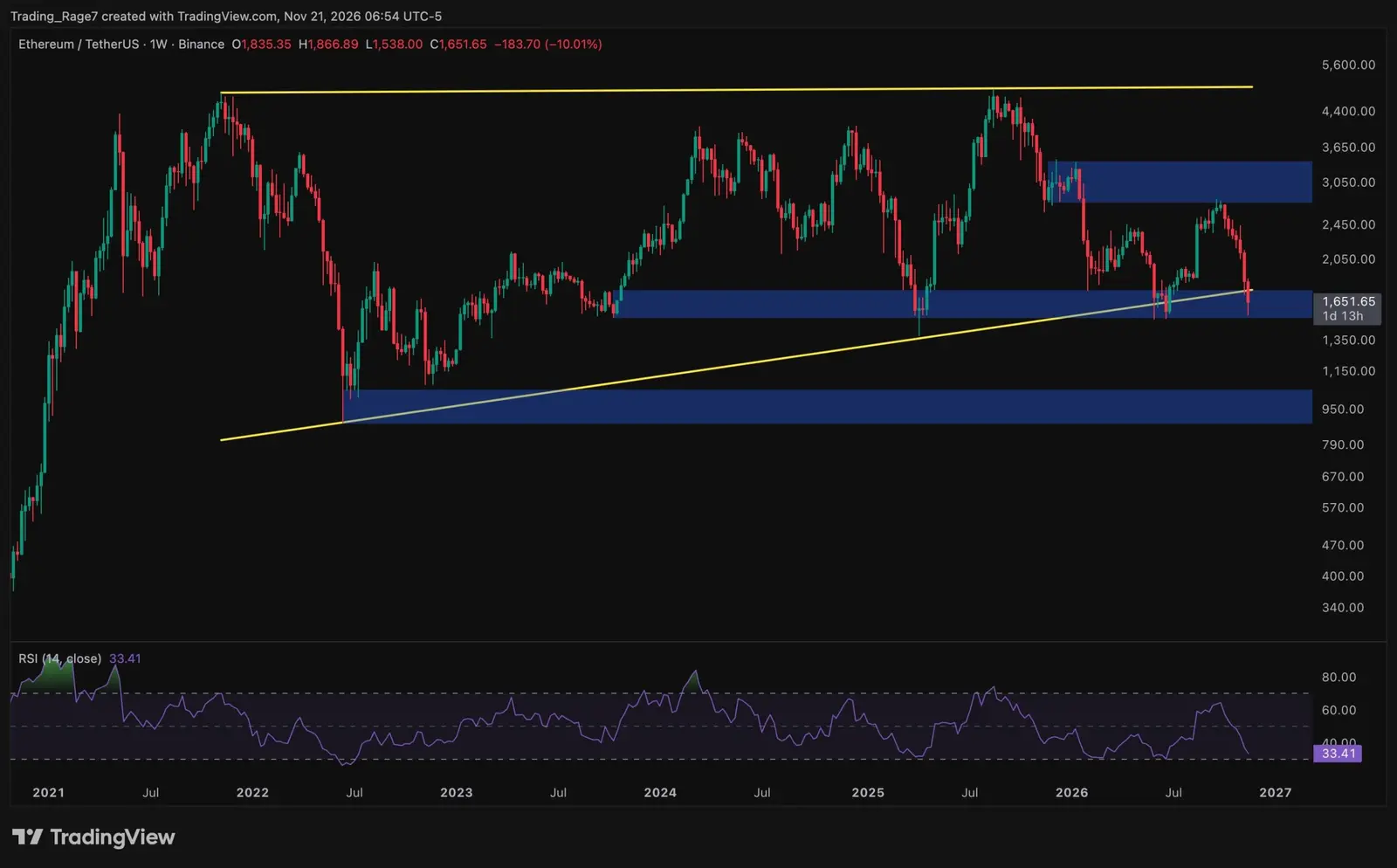 Ethereum price analysis: Did ETH hit its macro bottom after a 30% monthly drop?
 Bitcoin Reclaims $60,000 After Sharp Summer Selloff
Bitdeer paused large-scale sales to third parties. It uses almost all its rigs for its own mining. Velaura AI (formerly Auradine) redirected focus to AI chips. Canaan’s rig sales dropped 96% year-over-year in Q3. The company is pivoting to energy projects. Proto, from Block, lost its only major buyer. Consequently, miners seeking new rigs today mainly have Bitmain and MicroBT available. Those seeking non-Chinese hardware have limited choices.
The Mining Sector Oligopoly
According to the latest data from the Cambridge Digital Mining Industry Report, collected in June 2024, Bitmain held 82% of the market. Together with the next two largest players, they controlled over 99% of the total. These data were based on a survey of 46 mining firms. Collectively, these firms represented up to 48% of Bitcoin network hash rate. Cambridge describes this hardware market as extremely oligopolistic. Such concentration means that if something goes wrong at one manufacturer, a large part of the network’s machines could be affected.
The outcome of a U. S. national security investigation into Bitmain remains unknown. In November 2025, Bloomberg reported that an inquiry led by the Department of Homeland Security examined whether Bitmain machines could be remotely accessed for espionage or to disrupt the U. S. power grid. Bitmain denied presenting any risk to U. S. national security.
Additionally, Bitdeer, which split from Bitmain in 2021, manufactures its chips at TSMC in Taiwan. Bitmain reportedly also used TSMC. Chip fabs are already operating at maximum capacity due to the AI industry expansion.
Bearish for Bitcoin, Bullish
Efforts to diversify the Bitcoin mining hardware market have stalled this year. Mining generated less revenue per unit of hash rate than ever before. Large miners pivoted to AI data centers, reducing demand for Bitcoin mining rigs. Meanwhile, chip fabs were overwhelmed with AI-related orders.
The so-called „hashprice,” or what a miner can expect to earn per unit of hash rate per day, hit an all-time low in June. Publicly listed miners, as a group, mined below the break-even point in Q2. According to CoinShares, their average cash cost per Bitcoin was approximately $75,500 in Q2. BTC closed the quarter at a price of $58,400.
When Will Bitdeer Resume Sales?
While chip fabs are busy fulfilling AI-related orders, Bitdeer CEO Jihan Wu stated in May 2026 that the company prioritized its own mining over selling rigs. This was partly due to limited chip manufacturing capacity. For Bitdeer, it makes more sense to keep rare chips for its own mining operations and earn revenue from mining, rather than selling rigs.
„At this moment, the price of Bitcoin is still in a bearish situation, and if we sell mining rigs, we will have to sell them at a very unsatisfactory price,” Wu said in a conversation about financial results. In Q3 2026, revenue from SEALMINER sales dropped 97% to $0.3 million. Meanwhile, average hash rate of its own mining increased.
Leo Li, Bitdeer’s U. S. sales director, told Bitcoin.com News that large-scale third-party sales of SEALMINER are currently on pause. The company prioritizes deploying its mining rigs in its own mining operations and co-mining partnerships. „We believe this approach allows us to optimize capital allocation and capture greater long-term value from our proprietary mining technology,” Li said. He added that external sales could resume „depending on market conditions, production capacity, and our broader business priorities.” The U. S. sales director confirmed that the „vast majority” of Bitdeer’s active own-mining rigs were powered by SEALMINER. TSMC remains the sole chip fab partner.
Pivot to AI and Falling Sales
Meanwhile, Auradine was the main U. S.-designed alternative to Chinese mining machines. However, in March, the company renamed itself Velaura AI and refocused on AI chips. Strategy head Sanjay Gupta told TheEnergyMag at the time that the company would exhaust existing inventory. It would use unsold units for its own mining in third-party facilities.
Canaaan, the oldest name in the space, earned less