Institutional Capital Dampens Trends While Creating Sudden Liquidity Gaps
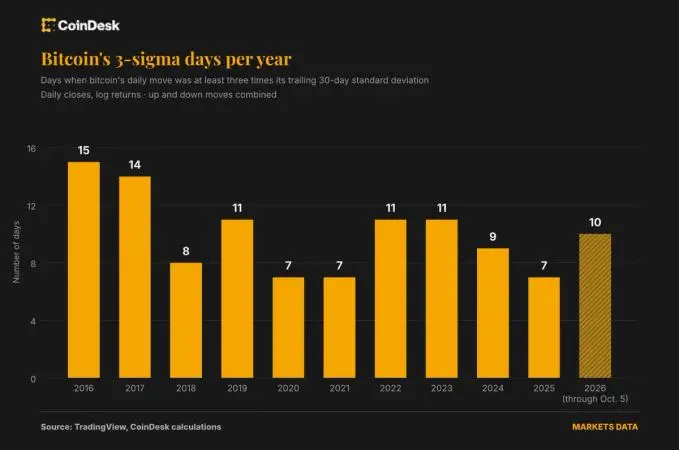
Bitcoin is displaying a contradictory financial pattern in 2026. While the cryptocurrency's overall annualized volatility has plummeted to historic lows, single-day extreme price moves are occurring more frequently than during previous market cycles, according to a recent market analysis.
Breaking news
 Starknet Weighs Move to Independent Quantum-Resistant Blockchain by 2027
 Coinbase Trains Compact AI Model That Outperforms Larger Systems in Fraud Detection
 Trader Rakes $1M on Papertrade, Then Loses $450K in a Night
 DWF Labs Sues BitGo in London Court Over $141M Token Lock-Up Dispute
The digital asset is behaving differently as institutional money changes trading dynamics. Overall price movement appears calm over long periods, yet sudden sharp moves still disrupt the market. Investors now face a new environment where traditional metrics may no longer measure digital asset risk accurately.
Why Are Extreme Trading Days Increasing Despite Lower Overall Volatility?
The broader decline in volatility stems from heavy institutional involvement. Traditional hedge funds and exchange-traded funds now dominate trading volumes, anchoring the price during normal trading conditions. This deep liquidity prevents the prolonged, wild price swings that characterized earlier crypto market cycles.
However, trading order books can still thin out rapidly during macro events. When unexpected news hits, automated trading strategies and liquidations trigger sudden price spikes. These abrupt moves cause massive single-day gains or losses before the asset quickly stabilizes again.
# What does lower annualized volatility mean for Bitcoin?
The disconnect between low average volatility and frequent price shocks challenges standard risk models. Quantitative analysts rely on daily variance to calculate potential downside. When extreme days occur without warning, traditional portfolio algorithms often fail to manage exposure effectively.
# Why do sharp price swings still happen so often?
Market participants are now forced to re-evaluate how they hedge against crypto market shocks. As institutional adoption grows, the market may continue to experience long stretches of quiet trading punctuated by violent, short-lived price dislocations.
Lower annualized volatility means that Bitcoin's price is generally more stable over long periods. This long-term stability is largely driven by institutional investors and increased market liquidity.
# How does this affect institutional investors?
Sharp swings occur when sudden events trigger automated sell orders and margin liquidations. These quick events temporarily exhaust market liquidity, causing brief but severe price movements.
Institutional investors must adjust their risk management systems. Standard financial models that assume steady price movements may understate the risk of sudden, single-day price shocks.