Bitcoin's Unexpected Calm Amidst Market Shifts
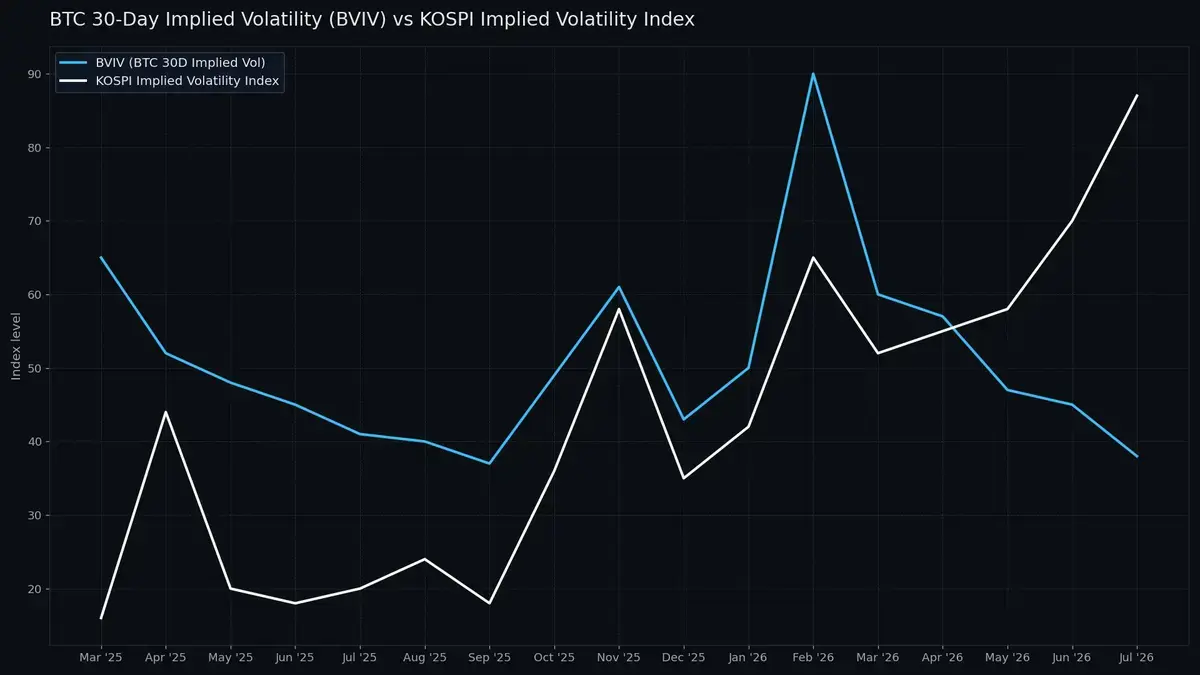
The intense excitement surrounding artificial intelligence is beginning to fade. This shift has led to an unexpected outcome in financial markets. Bitcoin's price swings are now less dramatic than those seen in South Korean stocks. This development marks a notable change in market dynamics.
Breaking news
 Starknet Weighs Move to Independent Quantum-Resistant Blockchain by 2027
 Coinbase Trains Compact AI Model That Outperforms Larger Systems in Fraud Detection
 Trader Rakes $1M on Papertrade, Then Loses $450K in a Night
 DWF Labs Sues BitGo in London Court Over $141M Token Lock-Up Dispute
This observation comes as investors re-evaluate high-growth tech sectors. The volatility comparison highlights a surprising maturity for the cryptocurrency. For years, Bitcoin was known for its wild price swings.
Data reveals a significant trend reversal. The implied volatility for Bitcoin has dropped below that of South Korea's KOSPI index. This suggests that traders anticipate smaller price movements for the digital asset. Meanwhile, the KOSPI, heavily influenced by tech giants, is experiencing greater uncertainty. Companies tied to the AI boom have seen their valuations soar. Now, some of that momentum is slowing down.
Why is AI's Frenzy Losing Steam?
This reduced volatility for Bitcoin could attract new types of investors. Traditional financial institutions often avoid highly volatile assets. A more stable Bitcoin might fit better into diversified portfolios. The KOSPI's increased choppiness reflects broader concerns. These include potential overvaluation in certain tech segments.
The initial burst of AI enthusiasm might be settling into a more realistic phase. Investors are now looking for tangible returns and sustainable business models. Many AI-related stocks saw rapid gains based on future potential. Now, the market is demanding concrete results. This cooling off period is natural after any major technological hype cycle. It allows for a more sober assessment of the underlying value.
The shift in volatility metrics points to a maturing crypto market. It also suggests a re-evaluation of traditional growth sectors. As the AI narrative evolves, investors are adjusting their positions. This could lead to further rebalancing across global markets.
Frequently Asked Questions
What does implied volatilitymean in this context? Implied volatility is a forecast of future price fluctuations. It is derived from options prices. A lower implied volatility suggests that traders expect less dramatic price changes.
Why are South Korean stocks particularly affected by AI trends? South Korea has a strong technology sector, including major players in semiconductors and electronics. These companies are deeply involved in AI development and manufacturing. Their stock performance is closely tied to the AI industry's fortunes.
What could be the long-term impact of Bitcoin's reduced volatility? A more stable Bitcoin could enhance its appeal as a mainstream investment. It might lead to greater institutional adoption and integration into traditional financial systems. This could further solidify its position as a legitimate asset class.