Why Gold Stands Apart in Copilot’s Analysis
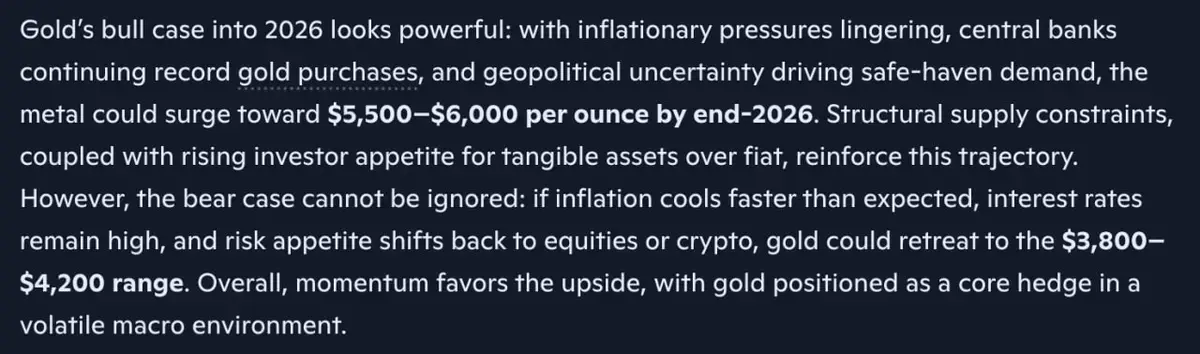
Microsoft’s Copilot artificial intelligence system has issued a bold forecast for gold, projecting the precious metal to trade between $5,500 and $6,000 per ounce by the close of 2026. The prediction emerges from an analysis that describes the current macroeconomic environment as „powerful as it has been in years,” positioning gold as the sole asset in its series to move in this direction.
Breaking news
 Bitcoin Security Could Be Threatened by 2046, AI Model Indicates
 XRP Ledger Patches Critical Bug That Could Have Minted 18 Trillion Tokens
 Aptos Launches AI Tools to Simplify Move Programming
 Regulatory Reach: CFTC Says It Can Oversight Nearly All Commodities
The AI model bases its outlook on a combination of macro indicators that it deems unusually strong. While other assets in the same series remain stagnant or decline, gold appears to be gaining momentum, according to the system’s internal assessment. The forecast suggests that the metal’s price could rise sharply, reflecting what Copilot describes as a „powerful macro setup.” Analysts note that such a surge would mark a significant departure from recent trends, where gold has hovered near historic highs but not breached the $5,500 barrier.
Copilot’s algorithm highlights that gold is exhibiting behavior not shared by other commodities or equities in its current evaluation set. The system points to a confluence of factors—such as persistent inflation concerns, geopolitical uncertainty, and central bank policies—that collectively create a favorable backdrop for the metal. By contrast, those same forces have not produced comparable price lifts in other markets, according to the AI’s internal metrics. The model’s confidence stems from its ability to synthesize large data sets, detecting patterns that human analysts might overlook.
Could Copilot’s Gold Forecast Be Accurate?
Industry observers caution that AI predictions, while increasingly sophisticated, still hinge on the quality of input data and underlying assumptions. Nevertheless, the forecast has sparked discussion about the potential for gold to outpace expectations. If the metal reaches the $5,500‑$6,000 range, investors could see a reshaping of portfolio strategies, with increased allocation to safe‑haven assets. Such a move might also pressure central banks to reconsider monetary policy stances, especially if inflation expectations remain elevated.
Skeptics ask whether an AI system can reliably anticipate market movements over a multi‑year horizon. Critics argue that unforeseen events—such as sudden shifts in fiscal policy or rapid technological breakthroughs—could derail even the most data‑driven projections. Proponents counter that AI’s capacity to process vast amounts of information gives it an edge in spotting long‑term trends that traditional models miss. The debate underscores the growing role of machine learning in financial forecasting, even as its limits remain a topic of contention.
If Copilot’s prediction materializes, the gold market could experience heightened volatility, drawing both speculative capital and defensive investors. A sustained price climb would reinforce gold’s status as a hedge against uncertainty, potentially prompting a wave of new entrants. Conversely, a failure to reach the forecasted levels might erode confidence in AI‑based forecasts, prompting a reevaluation of their role in investment decision‑making.
Frequently Asked Questions
What timeframe does Copilot predict for the gold price rise? The AI model projects gold reaching $5,500‑$6,000 per ounce by the end of 2026.
Why does Copilot view the macro environment as unusually powerful? The system cites a blend of persistent inflation, geopolitical risk, and central bank actions that together create a supportive backdrop for gold.
Should investors rely on Copilot’s forecast for their portfolios? While the prediction offers insight, investors should consider it alongside traditional analysis and remain aware of potential unforeseen market shifts.