
Summary
Kalshi stated that market favorites won in the elections. The detailed analysis of American midterm election markets shows exponential growth on the Kalshi platform. This performance is remarkable.
Breaking news
 Bitcoin Miners Face Hardware Shortage as AI Boom Strains Chip Supply
 Claude AI Forecasts Chainlink Plunge in 2027
 XRP Crashes to $0.87 as ETF Assets Fall Below $1 Billion
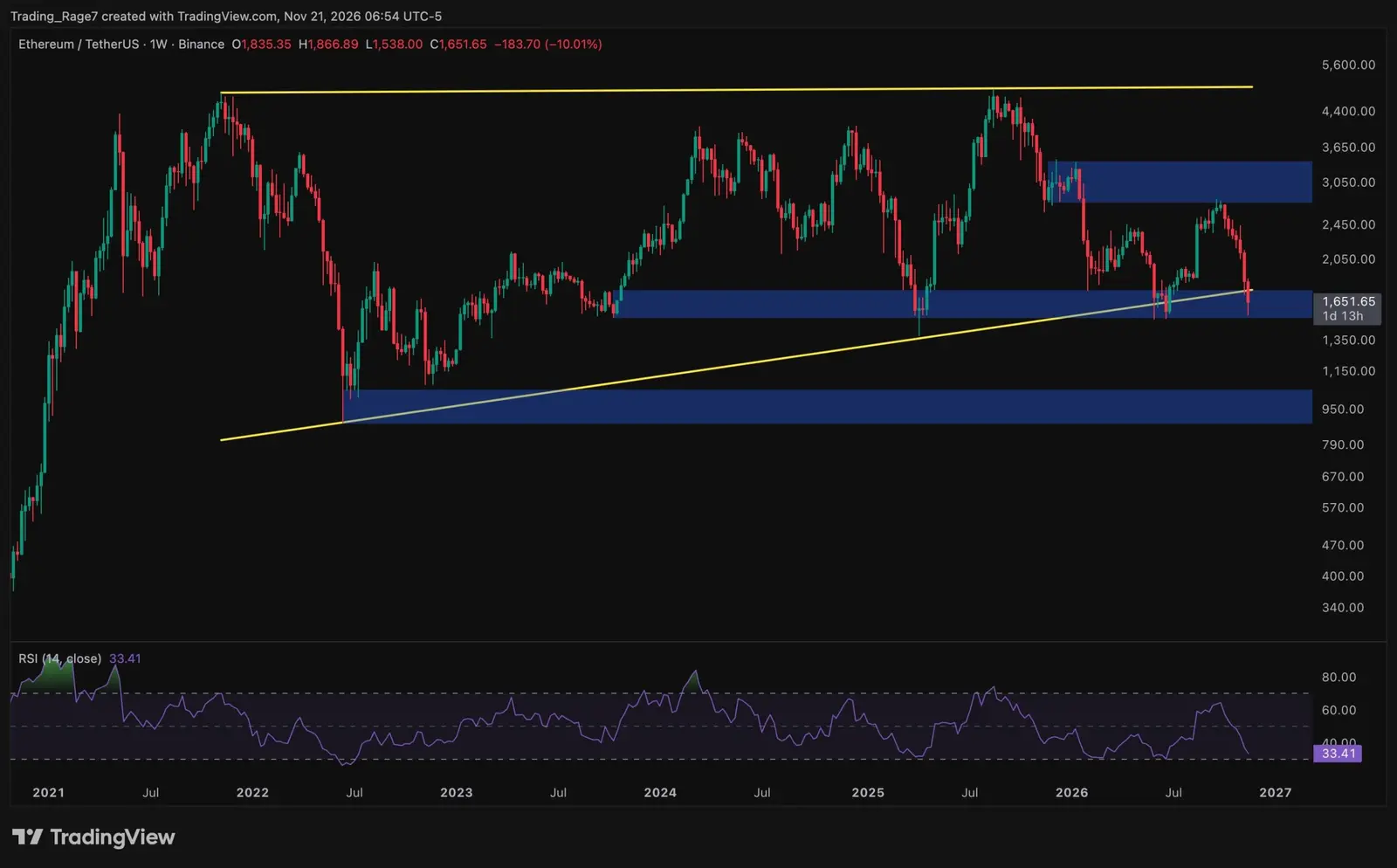 Ethereum price analysis: Did ETH hit its macro bottom after a 30% monthly drop?
Midterm Election Trading Surpassed the 2024 Cycle’s Total by More Than $1.2
Kalshi's report, based on November 4 data, noted market favorites triumphed in 479 out of 487 contests resolved by 6:00 AM ET. These contests covered various levels, including House, Senate, governorships, and attorney general roles. The platform recorded 356 wins in 360 House races and 32 wins in 33 Senate contests. Eight favorites failed across the monitoring period, yielding an estimated combined success rate of 98.4%, rounded to 98%. Some contests, like those in Alaska and Mississippi, were unresolved at the report's time.
Election Probability Insights
Kalshi indicated the House control market reached a 99% probability for a Democratic majority at 8:10 PM ET on voting day. Similarly, the 99% threshold for Senate control was met at 9:00 PM ET. Kalshi research examined trends from three months before voting until poll closures. Directional accuracy improved from 93.8% to 98.2%, a 4.4 percentage point rise. Brier scores dropped from 0.040 to 0.016, showing superior performance. A working paper by Nicole Kagan and Rubens Baiocchi clarified that a 51% priced successful prediction matches a 95% priced one in directional score.
Regulatory Oversight and Market Interest
Prior to the vote, U. S. markets saw intense scrutiny. On October 24, the CFTC monitored election markets. President Michael Selig commented on preventing potential manipulation. October 18 data showed combined open interest of $250 million on Kalshi and Polymarket. Kalshi contributed $210 million, while Polymarket added $40 million. Representative Don Davis introduced the No Betting on Your Own Race Actin October. This bill would restrict betting for federal candidates and their associated entities.
Market Evolution During Election Night
The platform's November 3 analysis tracked market movement as results emerged. At 6:55 PM ET, the House Democratic control probability stood at 97.2%. Later, Republican incumbent Greg Abbott lost his favorite status in the Texas gubernatorial race. Late-night updates showed traders backing Democratic victories in Texas and South Carolina. By 9:35 PM ET, the feed showed a 99% probability for James Talarico (Democrat) in the Texas Senate race. Annie Andrews led in South Carolina at 10:10 PM ET. The feed also hit 99% for Gina Hinojosa (Democrat) in the Texas governorship at 11:35 PM ET. These figures are market projections, not official election declarations.
Conclusion
Reuters confirmed prediction markets anticipated Democratic Congressional control but underestimated some candidates' strength. BETINT analysis cited by Reuters found 14 Democratic winners considered market underdogs a week prior. Market and poll performance was generally similar. These data show significant maturation in election prediction markets. This occurred despite regulatory oversight and complex administrative levels. The over 92% volume increase over the previous cycle highlights robust public interest in American political dynamics.